Whisper of the Compressor; or the White Music of the Cosmos
An informal guide to how an ordinary sound can pull you to the edge of existence.
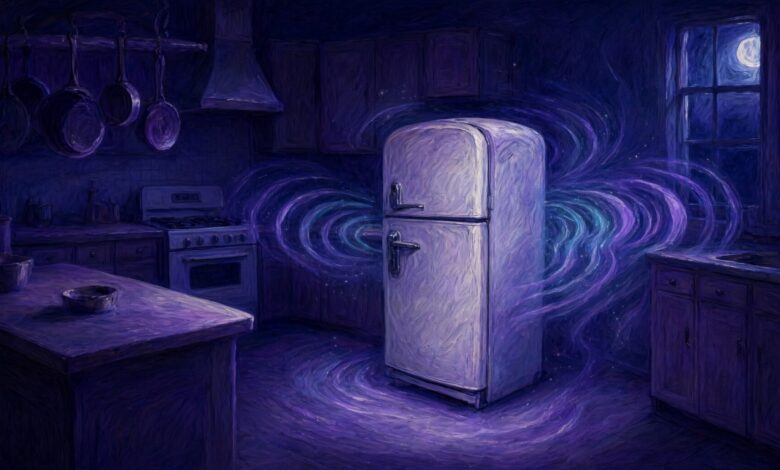
Midnight, and I, ilnaz, press my cooled forehead against the cold glass of the refrigerator, listening to the compressor’s whisper. The monotonous “mmmmmm” that occasionally changes its rhythm with a “clink”; like the breath of a sleeping creature. I remember those nights at my grandmother’s house, where the sound of that old refrigerator was my only companion in the dark room, and I, lying awake with wide eyes in bed, imagined this sound not as an intruder, but as a guardian of lonely nights. As if, with its buzzing, it filled the border between me and that terrifying absolute silence.
But today’s psychology sees this sound as something beyond a mere guardian; a “liberating stimulus.” The Ironic Process Theory suggests that the more we try not to hear a sound, the more sensitive our mind becomes to it. But perhaps this sensitivity is itself a gift. Within this lo-fi soundscape that the modern city has built for us, the refrigerator’s hum is like an anchor; a fixed point in the whirlpool of thoughts. This sound is so meaningless that it carries our mind through the narrow corridor of meanings and delivers it to a pure phenomenology.
And here, Heidegger whispers in my ear: in our daily lives, we don’t really hear “sound” at all; we hear the sound of “things”; the wooden cart, the motorcycle engine, and here… the refrigerator. To hear a “pure sound,” we must free the mind from the grip of everyday utility. And what better time for this liberation than midnight? When the refrigerator transforms from a household appliance into a “sound object”; waves that dance in the kitchen’s darkness like subatomic particles.
Its sound continues. This sound is the narrator of my existence; just as at night in my office, the ticking of the clock narrates the existence of my anxious clients. This sound is a paradox: it connects us to our earthly roots (home, food, security), yet through its monotony, it opens a window toward that eternal “Logos” that Heidegger speaks of; the sound of the cosmos behind the veil of this white box. And you, in the silence of this midnight, amidst all these meaningless sounds… where in this sonic wave have you lost your own voice?