Shelf Order: The Charter of Frequency, Not Obsession
We closed the chaos drawer; therefore, we are organized.
It begins with the gap between the salt shaker and the pepper mill. Have you ever noticed why, at midnight, your hand reaches for the teaspoon from the drawer without a second thought, yet to find the carrot grater, you must rummage through every cabinet?
The answer lies in “frequency of use.” In Ranganathan’s Five Laws of Library Science, there is a principle called “save the time of the reader.” Its practical translation in the kitchen: every object’s radius of reach equals the number of times we use it per week. This is not a matter of taste; it is a neurological imperative. In John Sweller’s Cognitive Load Theory, the limited capacity of working memory is addressed. Constantly shifting the kettle’s place consumes the very energy that should be spent on choosing the glaze color for the next ceramic bowl. Lotos, the painter, learned this lesson from canvas composition: high-frequency elements always sit at the focal point of vision, never in the margins.
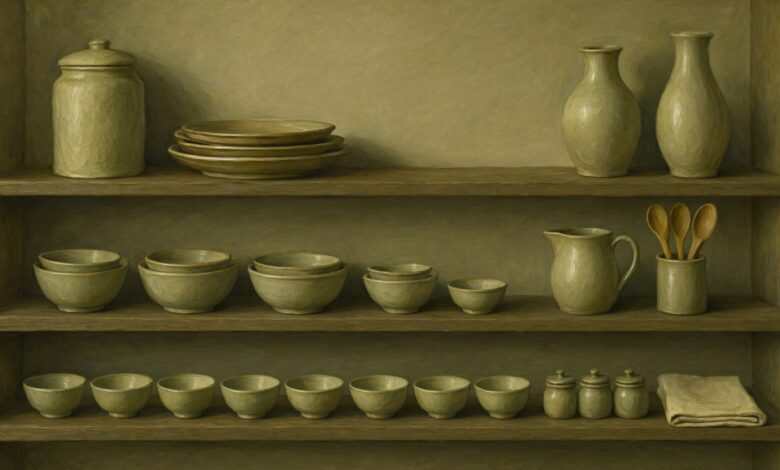
My rule for shelves is “proximity to usage.” The pot that cracks an egg every morning rests on the middle rack. The cake mold sits on the lower shelf. And the annual dinner platter stays behind the cabinet wall, labeled “emergency.” This method rescues the mind from endlessly reviewing the catalog of belongings. The shelf becomes a musical score where every note is played in its own place, so the daily symphony proceeds without a missed beat. Research in environmental psychology also confirms that spatial order based on patterns noticeably reduces the subconscious anxiety caused by “visual clutter.”
But let me confess a human weakness. This flawless logic has one disastrous exception: “the chaos drawer.” Where spare chargers, finished notebooks, and tangled cables are arranged according to the law of “the farther from sight, the better.” As long as that drawer stays closed, I remain, in my own eyes, a perfectly organized woman. (And thank goodness guests never have access to the depths of that drawer.)