The Strange Tale of Commissioning a Cat That Looked Like a Dog
when the client said "vibe" and I painted "anatomy"
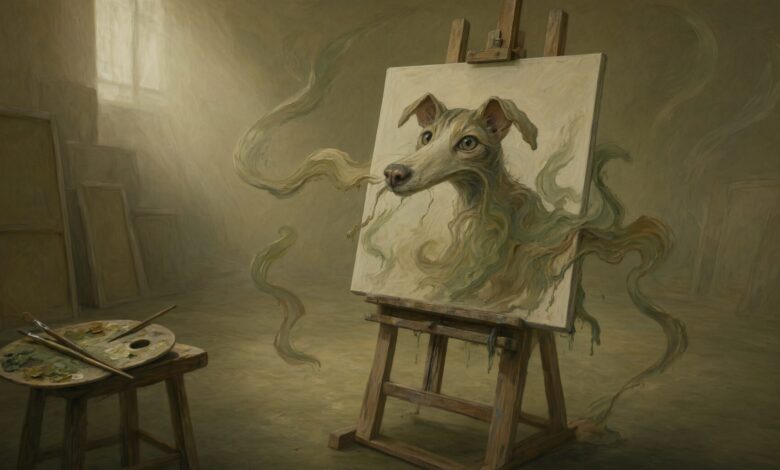
I put down the brush. The snout was longer than the standard for a domestic cat. The ears, floppy and limp. The canvas showed exactly what the client had asked for; but it was not at all what he had in mind. A cat that looked like a dog; a plastic paradox on a stretched canvas.
The story began when the client said: “Paint my cat, but make its spirit like a guard dog.” With my funnel-like mind, I turned that sentence into a formula. Input: “spirit = dog”. Output: “form = dog”. In figurative painting, form carries meaning. Faithful to visual principles, I elongated the snout and loosened the ears to embody “guardianship.” What I missed was that the client merely wanted a word to describe his cat’s “lovable chubbiness.” He said “dog,” but meant “volume.”
In Gestalt theory of visual perception, the brain imposes its own assumptions onto ambiguous shapes. Here, the client transferred a “feeling” to me, and I implemented it in “structure.” The communication error was not in technique, but in the decoding layer of vocabulary.
The solution was not repainting; it was redefining terms. In my studio, before any commission, I now mandate three questions: “Which exact physical feature matters most to you?”, “What feeling should be conveyed to the viewer?”, and “In which visual context is this feeling defined?” Outcome: the client asked for a cat with a round belly and erect ears. I painted exactly that. The painter is a translator of visual grammar, not a mind-reader of vague emotions.
I hung the original painting, frame and all, above my worktable. It reminds me daily that excessive order in word analysis can sometimes turn art into a canine nightmare. At least my painted dog does not bite. It just stares at me and, unconsciously, twitches its ears.