The Notebook of Peculiar Suitors; Laugh Without Regretful Tears
What do you say to people who mock your interests?
One night, after Lotous’s mother sent the third pleading voice message for “one last chance,” Lotous tossed her phone onto the sofa, turned to Ilnaz, and said, “Do you know what the strangest part is? They actually think these proposals are the ‘last train.’ As if life is a railway station and we are two passengers who have already missed the love train.” Without looking up from her book, Ilnaz replied, “The last train? I thought it was more like a shady bazaar where every new customer has a bigger flaw than the last.” They both laughed; a laugh that came not from joy, but from deep bewilderment.
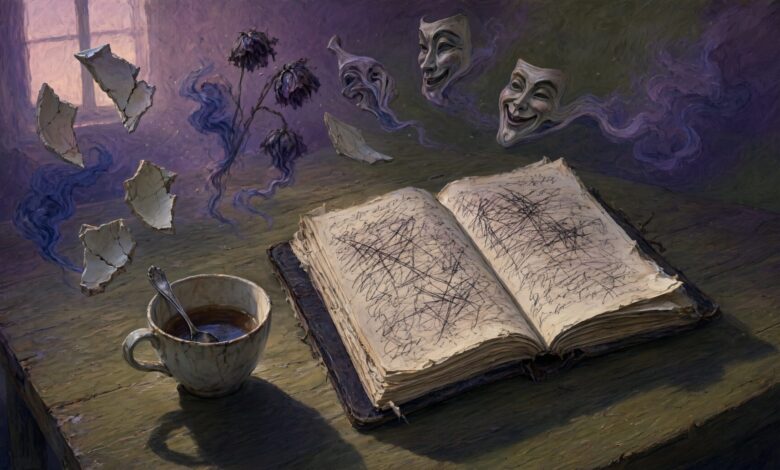
With the precision of an accountant, Lotous has jotted down a list of her mother’s suggested suitors in a notebook. There she writes: “First suitor: The cousin of my aunt’s husband. Occupation: household appliance salesman. First line: ‘Those who don’t buy paintings say paper is expensive.’ Second line: ‘Ma’am, a non-stick pot is better than a non-stick painting.'” In the psychology of humor, Freud stated that humor is a powerful defense mechanism; a way to turn unconscious suffering into a conscious smile. With her convergent mind, Lotous sees this exactly as the tool that allows her, without falling apart, to organize the suitor list and give each one a score for the “strangest line.” She says, “If I am going to cry, I would rather cry over my own jokes than over their words.”
Ilnaz, however, views humor through the lens of intuition. She recounts, “During one suitor meeting, a man introduced by my second uncle mocked my psychology major and said, ‘These talks are just for clueless kids.’ I smiled and said, ‘Exactly why I can easily spot your cluelessness.'” Ilnaz believes that dark humor is a mysterious mirror; behind every laugh lies a deep recognition of the situation’s absurdity. In family sociology research, it has been repeatedly noted that women facing traditional pressures often use humor as a survival skill; not to escape, but to redefine power. Ilnaz has seen this in her school counseling sessions as well: students who cope with poor grades through a bitter joke rather than tears often prove more resilient than others.
In the end, Lotous admits that sometimes this humor pulls her away from reality; for instance, when she is contemplating a painting of a burnt tree, she suddenly remembers the pot salesman’s line and her brushstroke trembles. And Ilnaz concedes that behind these laughs, a part of her heart is bruised; the bruise of a girl whom no one ever asked about her real dream. But they have both reached a common ground: laughing at this nonsense is healthier than crying over it, and this laughter is a form of silent protest. It says, “We are still alive, and we can still savor life’s dark humor with every cup of cold tea.” So keep that suitor notebook open; perhaps tomorrow someone will show up who is so ridiculous that you will have to add a new page. Without tears of regret, just with a smile.